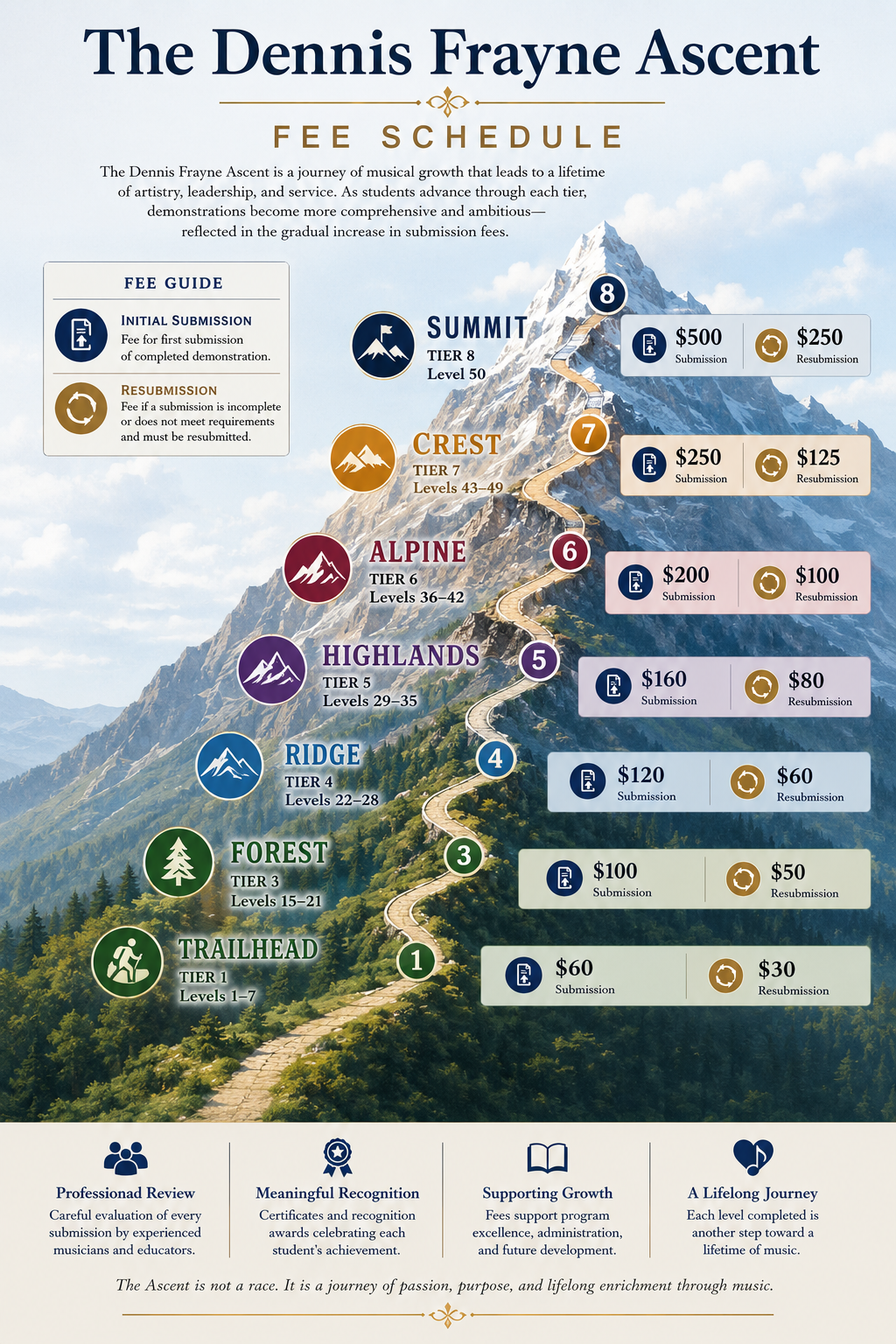
The Eight Tiers of the Dennis Frayne Ascent
Eight Tiers. Fifty Levels. One Connected Journey.
The Dennis Frayne Ascent consists of eight Tiers and fifty Levels. The first seven Tiers each contain seven Levels, comprising Ascent Levels 1–49. The eighth Tier, Summit, is different: it consists of a single culminating Level, Ascent Level 50. Every student begins at Trailhead Level 1 and progresses through the Levels in order, building new experiences and accomplishments upon earlier work.
The Tiers give shape to the larger journey. As students advance, the requirements broaden in scope and complexity and ask for increasing independence, creativity, responsibility, collaboration, leadership, and contribution. The pace may differ from one student to another, but the sequence remains the same.
The Ascent is not a race toward the Summit. Each Level represents musical work worth undertaking in its own right. Together, the eight Tiers provide students with a long-range framework for continuing to learn, make music, take on new challenges, and recognize what they have accomplished along the way.
🌱 Trailhead
Tier 1: Levels 1–7
Trailhead is where every student begins. These first seven Levels establish the habits and experiences that will support everything that follows: performing, singing, listening, reading, moving, creating, and learning to prepare musical work for others.
Students encounter piano, voice, folk and traditional repertoire, scales, rhythm, ear training, solfège, conducting, improvisation, arranging, composition, movement, and recital performance. The emphasis is not on rushing through fundamentals, but on beginning to connect them. Trailhead gives students an early experience of musicianship as something they do, understand, create, and share.
⛰️ Slopes
Tier 2: Levels 8–14
The Slopes build upon the foundation established at Trailhead. Students continue developing familiar areas of musicianship while encountering broader repertoire, greater technical demands, longer performances, and increasing responsibility for preparing their work.
Major and minor keys, harmony, conducting, ear training, solfège, improvisation, arranging, movement, singing, piano, and creative work become increasingly connected. Students also encounter a wider range of established repertoire and begin exercising greater independence in musical preparation and choice.
The Slopes represent a transition from beginning experiences toward increasingly capable and self-directed music making.
🌲 Forest
Tier 3: Levels 15–21
The Forest broadens the student’s musical world. Students continue strengthening piano, voice, musicianship, repertoire, and creative work while adding a required second instrument and taking on musical experiences that extend beyond individual study.
Performance, composition, arranging, conducting, collaboration, musical theater, poetry, literature, movement, and other artistic connections give students additional ways to understand and communicate through music. Public performance and increasingly substantial projects ask students to bring several areas of musicianship together.
The Forest encourages exploration as well as continuity: students strengthen what they already know while discovering new ways to participate in musical life.
🏔 Ridge
Tier 4: Levels 22–28
At Ridge, students begin working across an increasingly wide range of musical traditions, roles, and settings. Repertoire expands beyond a single tradition, while piano, singing, additional-instrument study, musicianship, composition, arranging, conducting, and performance continue to develop together.
Students increasingly participate with other musicians as accompanists, ensemble members, collaborators, composers, arrangers, and musical leaders. Choirs, community performances, creative projects, and other shared musical experiences require students to listen beyond their own part and contribute to work larger than an individual performance.
Ridge marks a growing shift from making music primarily for oneself toward participating responsibly with and for other people.
🌄 Highlands
Tier 5: Levels 29–35
The Highlands ask students to engage more deeply with musical structure, composition, interpretation, and historical understanding. Performance remains important, but students increasingly work with music from the perspectives of both performer and creator.
Students explore harmony, modality, musical form, a broad range of repertoire, original composition, and writing for different instruments and ensembles. Creative projects require increasingly deliberate musical choices and give students opportunities to develop ideas across larger forms and more complex musical settings.
The Highlands strengthen the connection among performing, creating, analyzing, listening, and understanding music.
❄️ Alpine
Tier 6: Levels 36–42
The Alpine expands musicianship into a wide range of musical traditions, environments, and collaborative situations. Students encounter repertoire and experiences drawn from classical music, jazz, blues, popular traditions, musical theater, sacred music, ensemble performance, and other forms of musical life.
Piano, singing, multiple instruments, conducting, composition, arranging, rehearsing, accompanying, and public performance come together through increasingly substantial work. Students participate in settings such as bands, choirs, orchestras, theater productions, worship services, community ensembles, and other public musical experiences.
The Alpine asks students not merely to know about different kinds of music, but to enter those musical settings, work with other people, and learn from direct participation.
⭐ Crest
Tier 7: Levels 43–49
At Crest, students take on some of the most substantial projects in the Ascent. Years of accumulated experience are brought into public performance, composition, arranging, conducting, collaboration, teaching, organization, and musical leadership.
Students may create works for soloists and ensembles, rehearse and conduct other musicians, organize public events, mentor younger musicians, present educational workshops, and undertake projects whose success depends upon planning, communication, preparation, and cooperation with other people.
The focus increasingly extends beyond personal accomplishment. Crest asks students to use what they have learned in ways that contribute to the musical lives of others.
🏆 Summit
Tier 8: Level 50
Summit is the eighth and final Tier of the Dennis Frayne Ascent. Unlike the first seven Tiers, which each contain seven Levels, Summit consists of a single culminating Level: Ascent Level 50. Reaching Summit represents completion of all fifty Levels of the formal Ascent, but it does not represent the end of musical growth. There will always be more music to encounter, understand, create, perform, and share.
At Summit, students bring together many of the experiences developed throughout the Ascent through substantial creative, organizational, technological, collaborative, and public musical work. Requirements include original composition, orchestration, conducting, film scoring, audio production, public performance, collaboration with ensembles, and the planning and direction of major musical events.
Summit therefore serves both as the culmination of the Dennis Frayne Ascent and as a point of departure. The formal Ascent is complete, while the student’s musical life continues beyond it.
One Connected Journey
Each Tier has its own character, but none stands alone. Trailhead introduces experiences that return in more developed forms on the Slopes. Work begun there expands through the Forest and Ridge. The Highlands deepen creative and musical understanding. Alpine places students in increasingly varied musical settings. Crest asks them to assume greater responsibility for work involving other people. Summit brings many of those experiences together at the conclusion of the formal sequence.
The Dennis Frayne Ascent does not ask students to compete for a place on this path. Every student follows the same sequence while taking the time their own learning and preparation require. Advancement comes through completion of the published requirements for each Level.
The result is not a collection of unrelated accomplishments, but a record of musical experiences accumulated over time: music performed, sung, heard, read, created, arranged, conducted, studied, shared, and made with other people.
Every step matters. Every milestone is earned. Each accomplishment prepares the way for what comes next.
Continue Exploring the Dennis Frayne Ascent
The Eight Tiers describe the complete fifty-Level sequence of the Dennis Frayne Ascent. To continue exploring the program:
Ascent Overview — Explore the philosophy and purpose of the Dennis Frayne Ascent.
How to Participate — Learn how students begin the Ascent and how participation works.
Demonstrations of Learning — Learn how students demonstrate their learning and how Demonstrations of Learning are reviewed.
Trailhead — Begin with Tier 1 and explore the published requirements for Levels 1–7.
Open to all. Earned by each. Celebrated by everyone.